Imin
Get in touch
Alidays is a travel agency. People now find trips through the influencers they follow, so Alidays wanted to work with them. We designed the platform for it.
Alidays is a travel agency. People now find trips through the influencers they follow, and Alidays wanted to work with them rather than compete. Over eight months in 2023 we researched what that could look like, designed a platform for it, and handed it over.
Alidays is a travel agency. People now find trips through the influencers they follow, and Alidays wanted to work with them rather than compete. Over eight months in 2023 we researched what that could look like, designed a platform for it, and handed it over, in four phases that each closed with a workshop. What came out of it is Imin, where an influencer plans a trip, travelers join it, and the agency books it.
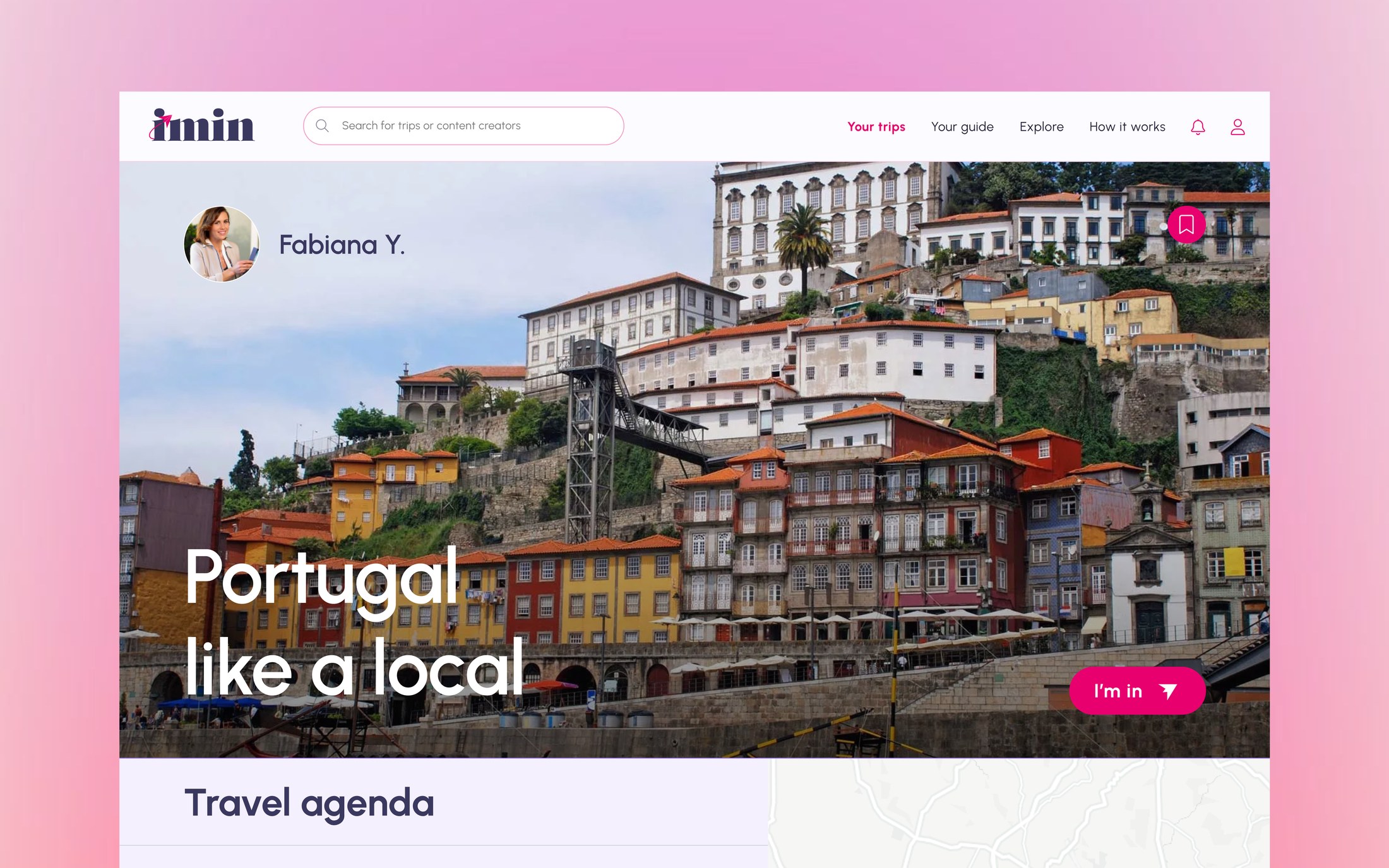
The problem
Trip planning has been significantly changed by the internet and social media. Travelers now look for inspiration and guidance on Instagram rather than from an agency.
Trip planning has been changed by the rise of the internet and social media. Our research revealed one pivotal shift: instead of relying on traditional travel agencies, travelers turn to Instagram for inspiration and guidance.
Influencers have become the new travel promoters, leaving less room for traditional travel agencies.
Alidays, a well-established travel agency, saw the same trend and wanted to find a way of working with influencers rather than against them.
We set out to understand why people turn to influencers over travel agencies, and what the opportunity was for Alidays in that.
We set out to understand why people turn to influencers over travel agencies, and what the opportunity was for Alidays in a shift that had already happened.
I worked on it with another designer from Poli.Design, over eight months and four phases, each closing with a workshop with the client.
I worked on it with another designer from Poli.Design, overseen by a senior colleague there, across eight months and four phases.
Each phase closed with a workshop alongside the client, running from kick-off through concept validation and the visual concept to business model validation.
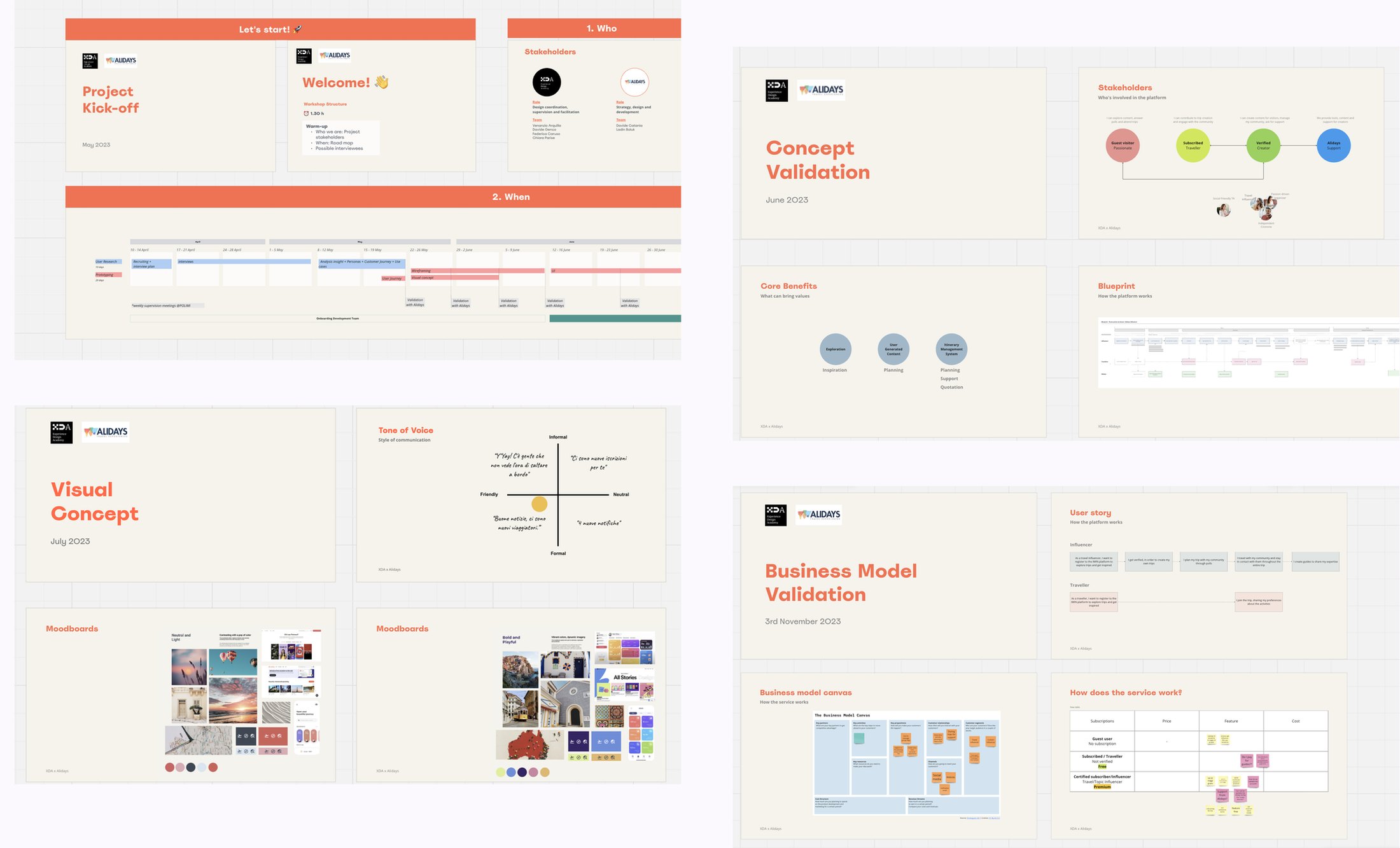
It was set up as a startup inside the company, so we had the creative freedom to design our own visual language and tone of voice.
It was set up as a startup inside the company, so we had the creative freedom to design our own visual language and tone of voice. As designers we usually need to work within existing brand colors and identity, so being able to build our own was one of the most enjoyable parts of the project.
That freedom is rare, and it made the whole thing genuinely fun to work on.
What I found
Talking to influencers
Five qualitative interviews with three main findings: their trip planning process is fragmented, their pain point is a lack of trust from service providers, and their advantage is their niche expertise.
We interviewed five travel influencers about how they make money, which tools they plan trips with, and how they manage their relationships with their communities.
We started by trying to understand how influencers organize travel and what they need while they do it. We conducted five qualitative interviews to analyze how they monetize their content, which tools they plan trips with, and how they manage their relationships with their communities.
What they told us
We had three main findings:
- A fragmented planning process. Trips were planned across Excel, Google, social media and paper at once, which made it hard to keep track of information.
- Little trust from service providers. Hotels and restaurants doubted the credibility of smaller influencers, who then struggled to book for a group in advance.
- Expertise in a niche. What made travelers drawn to influencers was their insider knowledge about specific hobbies and locations.
- A fragmented planning process. Influencers planned trips across Excel, Google, social media and pen and paper at once. This approach made it difficult to track and organize information, giving rise to the opportunity for a unified touchpoint.
- Little trust from service providers. Micro-influencers with fewer than 10,000 followers struggled to book in advance for large groups, because hotels and restaurants doubted their credibility.
- Expertise in a niche. The main appeal of influencers was their passion and expertise in specific hobbies or locations. A vegan influencer couple, for instance, specialized in organizing vegan trips to Italy, so travelers could enjoy the trip without worrying about finding suitable places to eat. This level of insider knowledge was often not provided by traditional travel agencies.
An agency has credibility and no intimacy. An influencer has intimacy and no credibility.
What I changed
The concept
Imin brings together what each side already has: the influencer's niche and audience, and the agency's catalog, credibility and booking.
Imin is where those two halves meet. Alidays reaches audiences it would have found difficult to get to on its own, and influencers get an agency behind them. It takes its name from the “I'm in!” people say when they see a trip they want to be on.
- Exploration and inspiration. Influencers get Alidays' catalog, and write guides from their own trips that inspire other members of the platform.
- Trip planning in one place. One tool covering all steps of trip planning: itineraries, daily agendas, polls, participants and documents.
- The agency's credibility and support. Agents provide support and handle the bookings influencers could not manage alone.
- Exploration and inspiration. Influencers get access to the Alidays catalog: prepackaged trips, themed activities and destination details. In exchange they write guides from their own trips, providing inspiration for other members of the platform.
- Trip planning in one place. Influencers get a tool designed for them, covering all steps of trip planning: getting inspired for destinations, building itineraries, creating daily agendas, creating polls to get input from the community, and managing participants and all trip documents.
- The agency's credibility and support. Agents support influencers by managing the bookings for transportation, accommodation and activities, as well as providing consultancy.
Three sides of one trip
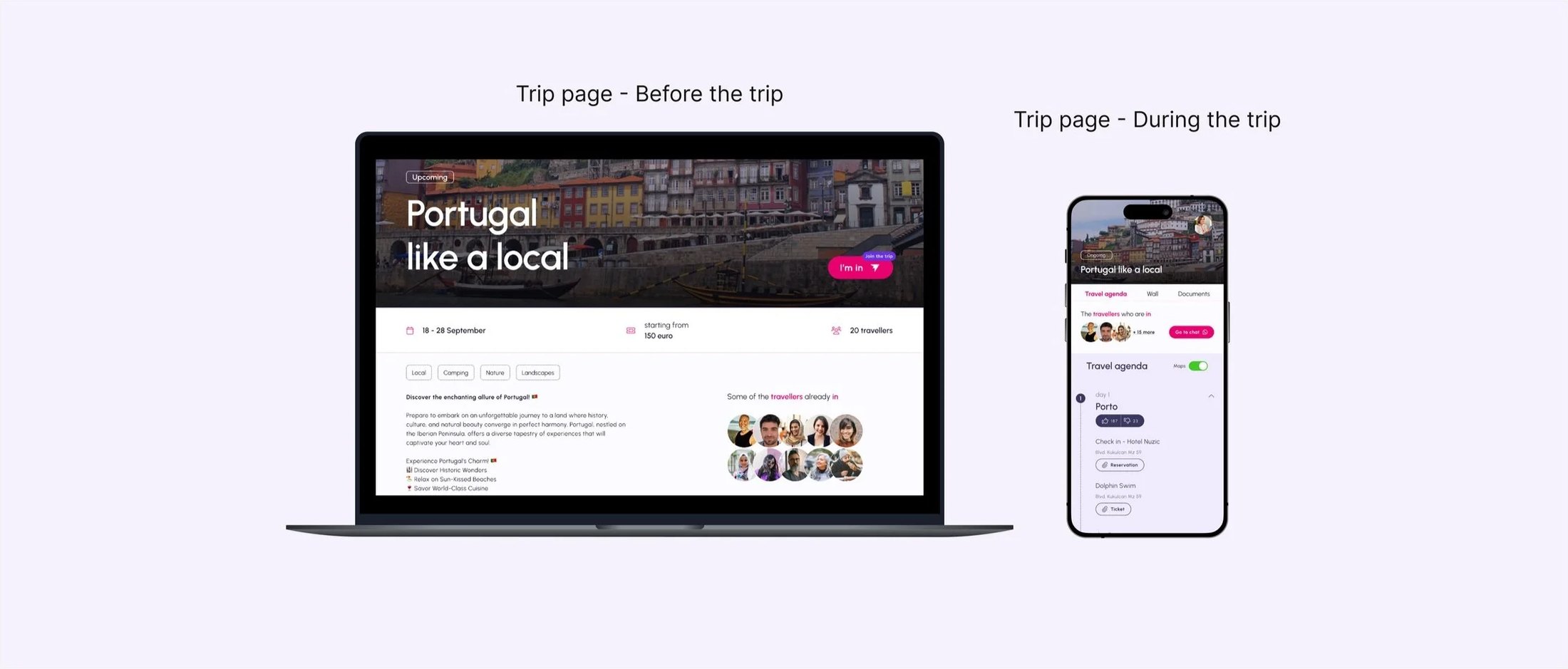
Every trip involves three groups: the influencer running it, the travelers deciding whether to come, and the agency booking it.
The hardest part was the stakeholders. Every trip on Imin involves three groups with different needs: the influencer organizing it, the travelers deciding whether to come, and the agency doing the booking.
In order to design for all 3, we had to understand how each of them works.
In order to design for all 3, we had to understand how each of them works. How does an agent hold twenty rooms for a group that has not fully signed up yet? Does a quotation come back first, and who sees it? When the influencer wants to swap a hotel, what does that conversation look like, how long does it take, and who is waiting on whom? We spent weeks mapping those exchanges so that what we designed would fit the way the agency already works.
Building it
Two user types share most of the product while wanting different things from it.
We followed a double diamond, adjusting it as the project needed. Interviews and personas to understand the problem, a blueprint and information architecture to narrow it down, then wireframes, a design system and the prototype.
We followed a double diamond, adjusting and iterating as needed. Discover gave us the interviews, the analysis, the personas and the customer journey. Define gave us the blueprint, the information architecture, the use cases and the wireframes. Development was the visual concept, the design system and the prototype, and delivery was the business model canvas and the development plan.
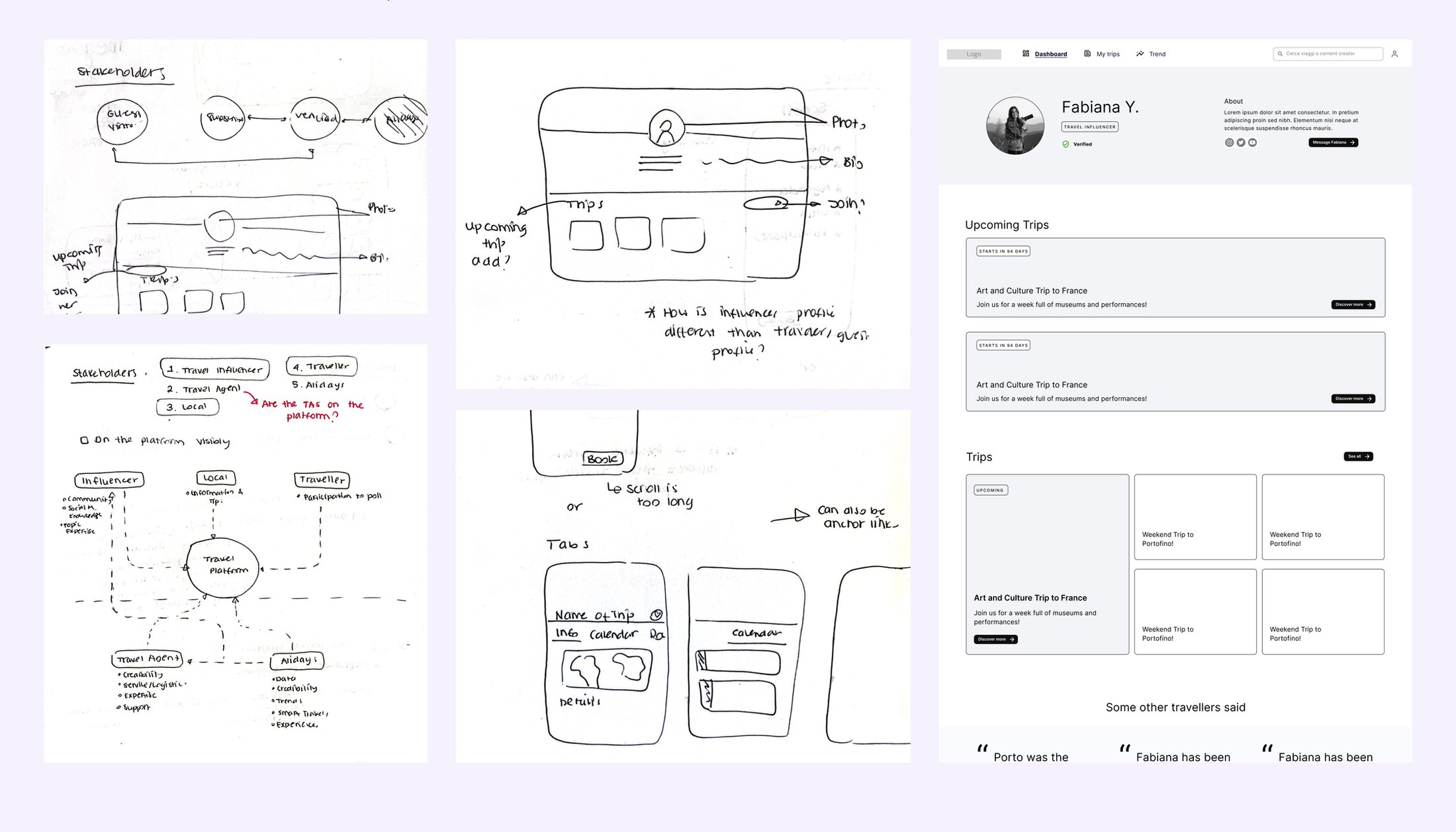
A lot of it was sketched before it was designed. Whether an influencer's profile should look different from a traveler's, how long the top of the trip screen could run and where the tab bar belonged were all questions we asked ourselves before jumping into design.
Two user types also share most of the product while wanting quite different things from it: an influencer is running the trip, and a traveler is deciding whether to join it. Most screens had to serve both of those at once without splitting into two products.
The trip builder
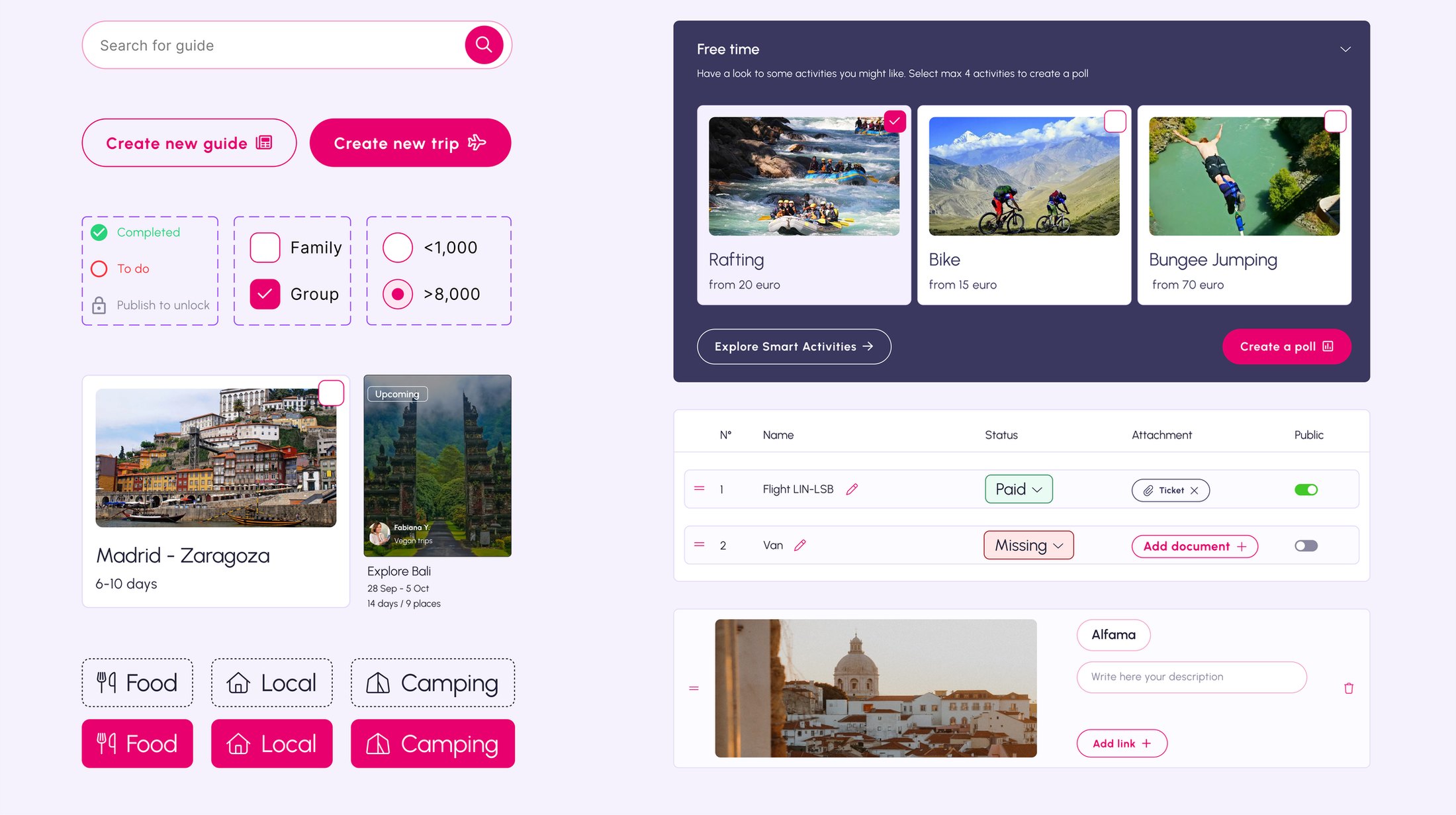
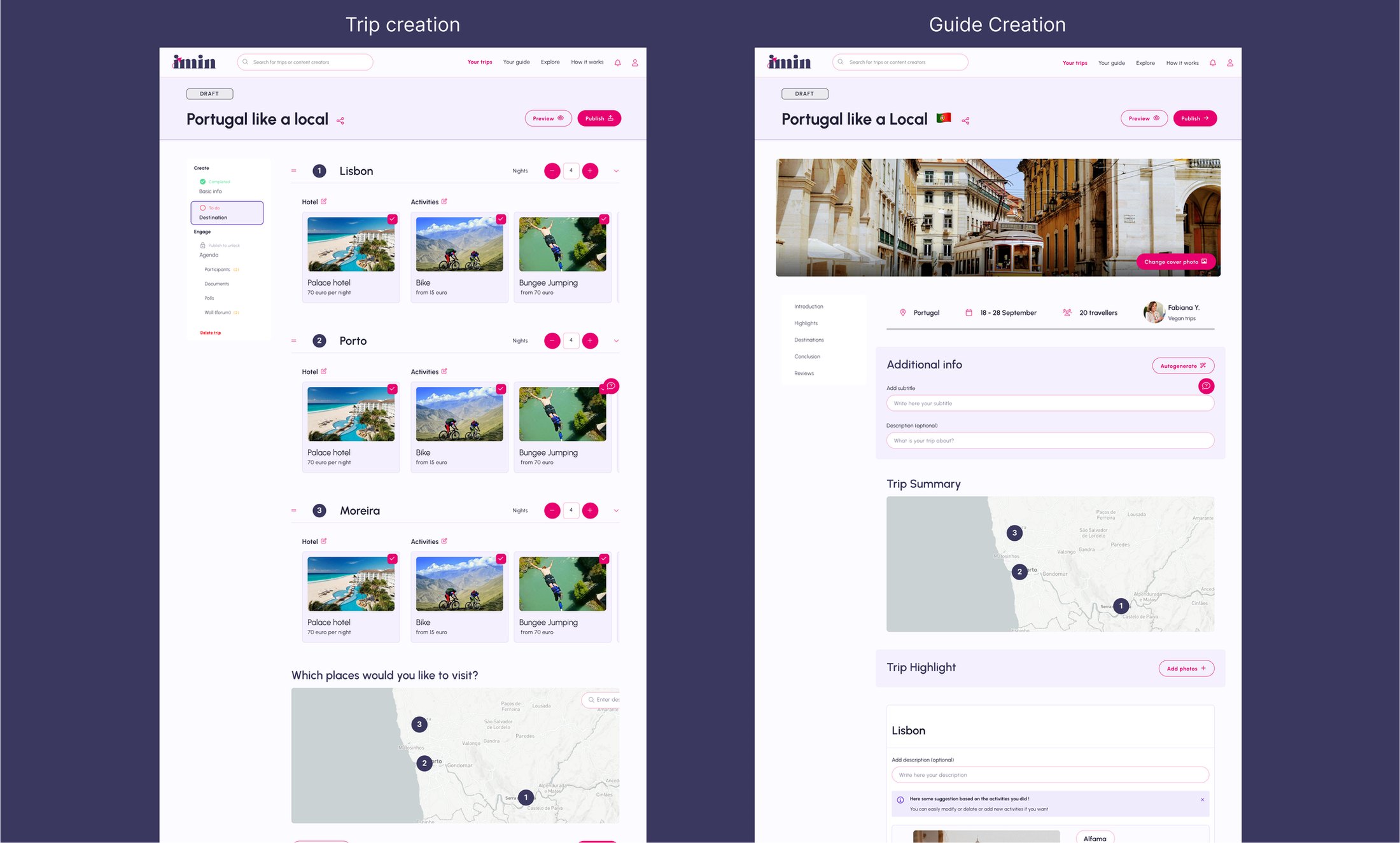
The biggest piece of the project was the flow an influencer goes through to build a trip.
We wanted it structured enough to guide them through the process, and flexible enough that they could still work in their own way.
So some steps had to be finished before the next one opened, while other sections were free to jump back and forth between.
So we spent a long time on sequence. The builder ended up split in two, creating the trip and then engaging people around it, with each step showing whether it was complete.
So we spent a long time on sequence. What is the honest first step? Is it the destination, the dates, or the kind of trip it is going to be? What needs to be settled before the next thing can be asked, and what can safely wait until later? The builder ended up split into two halves, creating the trip and then engaging people around it, with each step showing whether it was complete.
After we built the base, we focused on smaller functionalities that took the user experience from good to great: exporting the contacts of everyone who signed up, a running view of who has paid, one place for the documents, and polls for the parts of the trip the group should decide together.
Polling is the part I like most, because it is a fun way of engaging all the travelers without the messiness of a group chat. The organizer puts up a few options for activities or destinations, everyone votes, and the winning item is placed in the calendar automatically.
Where it stands
Delivered the prototype, the design system and the reports, and it went into development.
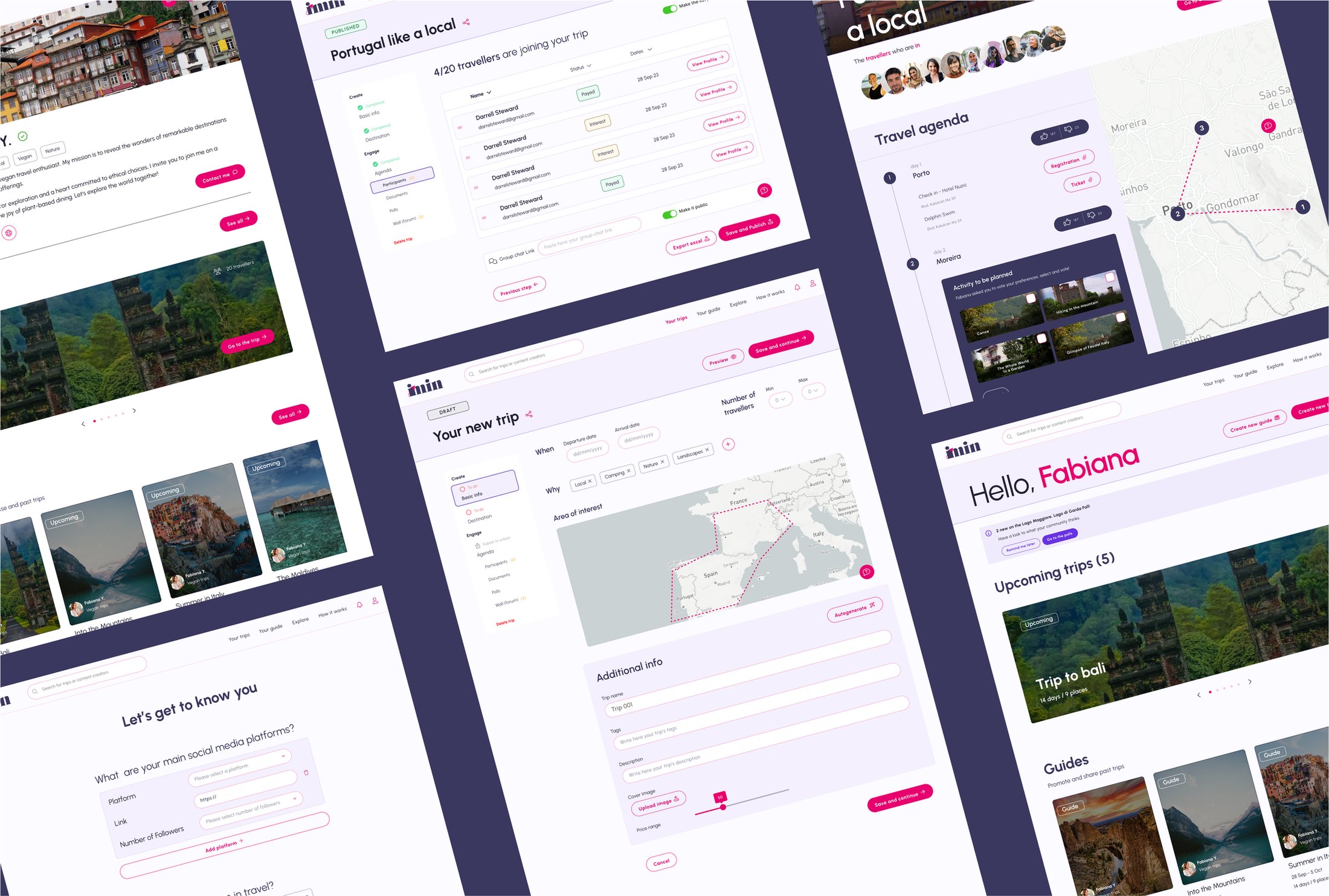
The project was completed and handed off to the client: the prototype, the design documentation, and a report covering each phase. It went into development after that.
The project was completed and handed off to the client: the prototype, the design documentation, and a report covering each phase along with the outcomes of every workshop. It went into development after that, and should be in use now.
What I learned
- The business model shapes the screens. Knowing who pays and why also settled many design decisions.
- A product has to fit how the business already works. We had to learn the processes of both the agency and the influencers in order to cater to both.
- Designing from scratch is fun. I had missed the moodboards and the rest of it, and this was a reminder of how much of that usually comes decided.